Table of contents
- What is Business blog failure and why is it important?
- How Business blog failure happens in practice?
- Why company blogs die after six months?
- Step-by-step – how to avoid Business blog failure
- Common mistakes and how to avoid them
- How Business blog failure impacts your results, SEO, and growth
- When you especially need to prevent Business blog failure?
- How to combine blogging with other tools and strategies?
- What to do when you hit problems or warning signs?
- Who should implement it / who can help?
- Business blog failure – most frequently asked questions
Most company blogs don’t “fail” because blogging stopped working. They fail because the blog never becomes a reliable system. The first weeks are easy, then priorities shift, posts get delayed, and after a few months the blog turns into a quiet corner of the website that nobody touches.
What is Business blog failure and why is it important?
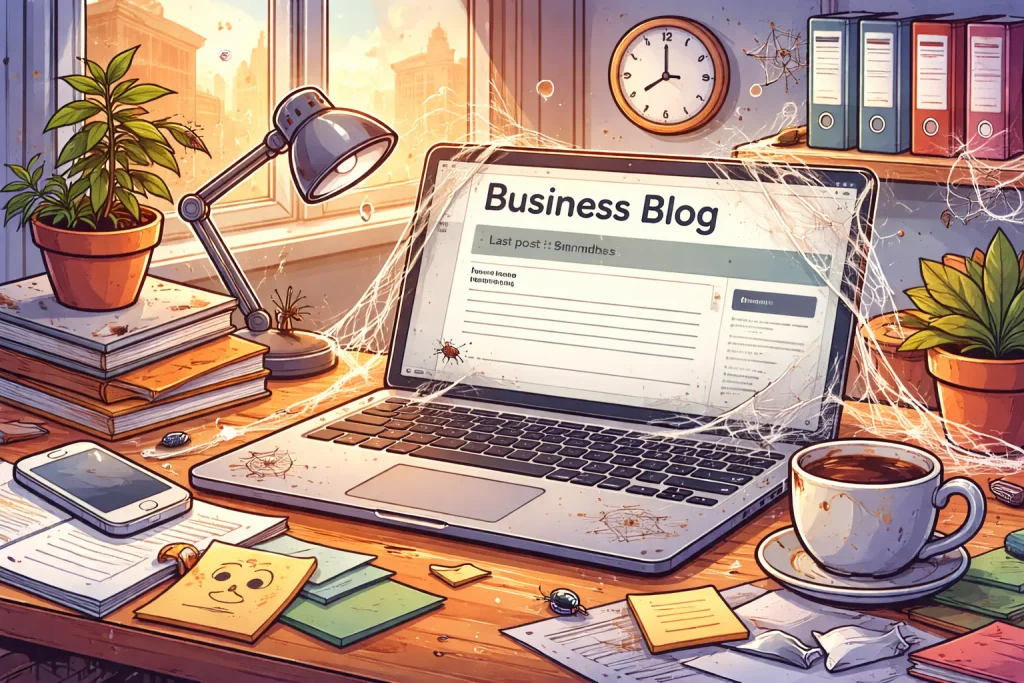
Business blog failure is what happens when a company starts a blog with good intentions, publishes for a few weeks (or months), and then quietly stops. Not because “blogging doesn’t work” — but because the blog never becomes a system. It stays a side task that loses against urgent work.
It matters because a blog is one of the few marketing assets that can compound over time: it can bring search traffic, educate customers, answer objections, and support sales — even when you’re not actively spending money on ads. But only if the content is genuinely helpful and built for real people, not just for rankings.
How Business blog failure happens in practice?
In practice, Business blog failure rarely looks like a clear decision to stop blogging. Much more often, it’s a slow loss of momentum. A company starts publishing with energy, but without a clear system behind it. When the first posts don’t bring visible results, the blog quietly moves down the priority list.
Another common scenario is treating the blog as a creative exercise instead of a business tool. Articles are written based on what feels interesting at the moment, not on what customers actually search for or ask about. Over time, the content becomes disconnected from real business goals, so it’s harder to justify spending time on it.
There is also the issue of ownership. When no one is clearly responsible for the blog, publishing becomes irregular. Small gaps turn into long breaks, and after a few months the blog is technically still there — but no longer alive.
Why company blogs die after six months?
Most company blogs fail because expectations are set wrong from the start. Blogging is often treated as a quick win, while in reality it’s a long-term channel that needs consistency and direction. When results don’t appear fast enough, motivation drops and publishing slows down.
Another reason is the lack of a direct link between content and business value. If it’s unclear how blog articles support sales, SEO visibility, or customer trust, the blog becomes an “extra task” instead of a core part of marketing. And extra tasks are the first to disappear when time gets tight.
Step-by-step – how to avoid Business blog failure
The fastest way to prevent Business blog failure is to stop treating the blog like a “when we have time” project. A blog survives when it has one clear purpose, a simple plan, and a repeatable workflow. Without that, even good writing won’t help, because consistency will always lose to urgent tasks.
Start by defining what the blog is supposed to do for the business in the next three months. Not five goals at once — one. Then build your topics around real customer questions that are tied to what you sell. When your blog answers the same problems people bring to sales calls or email inquiries, it becomes easier to justify publishing, because it supports revenue and saves time.
Finally, make publishing realistic. One solid, useful article per week (or even every two weeks) is better than bursts followed by silence. What matters is keeping the machine running: writing, publishing, linking internally, and improving older posts as you learn what works.
Common mistakes and how to avoid them
A common mistake is writing content that sounds “nice” but doesn’t solve anything specific. If an article could fit any industry, it usually won’t perform in yours. The fix is simple: make every post answer a real question your customer actually asks, using your own examples, numbers, or processes — the kind of details competitors don’t include.
Another mistake is publishing without thinking about what happens next. If a post has no clear next step, it may get attention but won’t turn into leads. A practical blog connects each topic with a natural action, like checking an offer, sending an inquiry, or reading a related guide that moves the reader closer to a decision.
How Business blog failure impacts your results, SEO, and growth
When a blog dies, your website stops building momentum in search. New pages are not added, internal linking slows down, and Google has fewer reasons to crawl and reassess your site. Over time, you lose opportunities to rank for long-tail queries — the exact searches that often bring the highest-intent visitors.
It also hurts growth in a quieter way: you lose the chance to educate people before they contact you. A strong blog reduces friction by answering doubts about pricing, process, timing, and “why you.” Without that layer, leads come in colder, conversations take longer, and many people drop off because they don’t fully understand what they’re buying.
When you especially need to prevent Business blog failure?
You need to take Business blog failure seriously when your customers don’t buy instantly. If people compare options, ask questions, need trust, or need time to decide, your blog can do a big part of that work before they ever contact you. Without it, you rely more on direct outreach or paid ads, and every lead starts from a colder point.
It’s also critical when you’re in a competitive market and you want a quieter advantage that builds over time. If your competitors publish consistently, they gradually fill Google with answers, examples, and proof. Even if their service isn’t better, they will look more present, more helpful, and more established — and that affects who gets the first message from a potential customer.
How to combine blogging with other tools and strategies?
A blog becomes much stronger when it’s connected to the rest of your marketing, not sitting alone. The same article can support SEO, make sales conversations easier, and feed your social media or newsletter — but only if you plan it that way. When one piece of content is reused across channels, it stops feeling like “extra work” and starts feeling like smart leverage.
In practice, you want your blog to guide people through small decisions. A post should not be an island. It should link to related content, point to your service page when it makes sense, and give the reader a simple next step. That’s how you turn “reading” into progress toward a purchase.
What to do when you hit problems or warning signs?
If your blog is already struggling, don’t fix it by forcing more writing. Fix it by removing friction. Usually the problem is not effort — it’s that the system is unclear. People don’t know what to publish next, how to judge if a topic is worth it, or what “success” even looks like.
The quickest rescue is to focus on what’s closest to business value. Improve the posts that already have impressions or traffic, make them clearer and more useful, strengthen internal linking, and connect them to a natural next step. This is often faster than constantly publishing new articles, and it brings back motivation because you can actually see movement.
Who should implement it / who can help?
A business blog needs an owner. Not “marketing” as a general idea, but one person who keeps it moving: chooses topics, sets priorities, makes sure posts are published, linked, and improved over time. Without ownership, the blog becomes a shared responsibility — and shared responsibilities usually become nobody’s job.
For small companies, the most practical setup is often a simple split: you provide real expertise and examples from your business, and someone else builds the structure, writes or edits, handles SEO basics, and keeps consistency. This saves time and prevents the blog from dying when things get busy.

Business blog failure – most frequently asked questions
Below are short answers to the questions that come up when a company blog loses momentum and you want to fix it without turning it into a full-time job.
How do I know if I’m heading toward Business blog failure?
If publishing feels random, results are unclear, and you keep postponing “just one more post,” you’re already on that path. The main sign is not low traffic — it’s lack of a system and ownership.
What’s the biggest reason blogs die after six months?
Because the blog is not connected to business value. If posts don’t support sales, customer trust, or SEO visibility in a clear way, blogging becomes “optional,” and optional work disappears first.
What should I write about if I don’t have time for “creative content”?
Write what customers already ask you. Pricing logic, timelines, common mistakes, comparisons, “how it works,” and “what to expect” are not boring — they are exactly what helps people decide.
Should I delete old posts that didn’t perform?
Not automatically. Often it’s better to improve or merge them, especially if they already have impressions. Delete only when a post is irrelevant, misleading, or can’t be made useful.
Can AI content cause Business blog failure?
It can, if it produces generic articles that don’t reflect real expertise. AI can help with structure and speed, but the content still needs your examples, your decisions, and your “this is how it works in real life.”
What’s the fastest way to revive a dying blog?
Stop publishing random new topics and upgrade what already has potential. Improve clarity, add missing answers, strengthen internal links, and connect posts to a next step that makes business sense.
MY SERVICES
Choose the service that fits your project
Choose the area where you need a concrete implementation, better results or further development.
Search engine optimization
Content, landing pages, internal linking and ongoing organic visibility growth.
View SEO servicesWordPress & WooCommerce Websites
New websites and online stores, technical improvements and further development.
View website servicesGoogle Ads | Offer
Campaign setup, management and ongoing optimisation.
View Google Ads servicesSponsored posts and link building
Publications, content and external links matched to your industry and project.
View link building services