
Table of contents
- What the problem usually looks like
- Why the first diagnosis matters before rewriting or installing tools
- What not to assume too early
- What to check in Google Search Console, search results, or the page itself
- How to separate indexing, intent, content, and technical problems
- Where website structure and internal links often change the result
- When content quality is the real SEO problem
- Signs the page is too generic
- How to prioritise fixes without changing everything at once
- What usually deserves lower priority
- How to turn the diagnosis into a realistic action order
- Thin service pages – Frequently Asked Questions
Many service pages stay weak in search even after redirects are cleaned up, metadata is improved, and crawl issues are reduced. That often happens because technical SEO removed friction, but did not solve the bigger problem: the page still gives Google and users too little to work with.
When visibility is low, it is tempting to keep changing plugins, titles, or schema settings. In practice, that usually creates more noise. A better starting point is to ask a simpler question: is the service page actually strong enough to deserve visibility for the searches it targets?
What the problem usually looks like
A thin service page often looks “fine” at first glance. It has a heading, a few short paragraphs, a contact form, maybe a stock image, and some basic SEO settings. It may even be indexed. But the page still struggles because being indexable is not the same as being competitive. If the content is generic, vague, or nearly identical to other pages on the site, search engines may treat it as low-value.
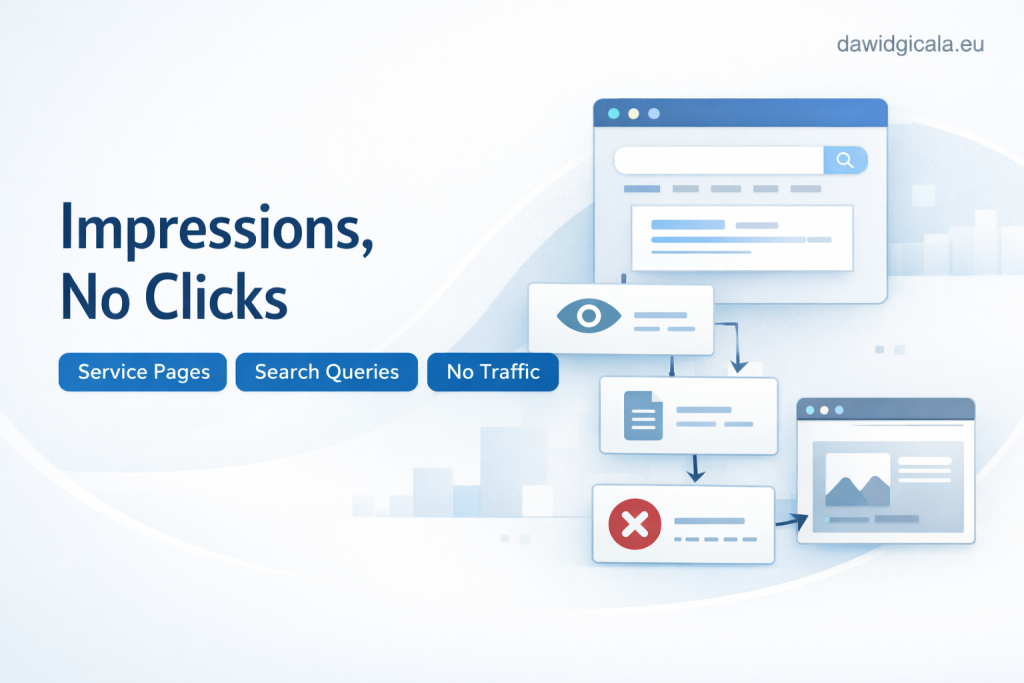
A common symptom is impressions without meaningful clicks, or a page that appears for very broad and weakly related queries but not for the searches that matter. For example, a plumber’s “boiler repair” page may mention the service only briefly, then spend most of the page talking generally about the company. The likely cause is poor topic coverage. The next thing to check is whether the page clearly explains the service, who it is for, what problems it solves, and in what context.
Why the first diagnosis matters before rewriting or installing tools
Thin service pages are often misdiagnosed as a purely technical issue. Site owners install another SEO plugin, rewrite title tags three times, or add FAQ schema without changing the actual page substance. That can waste time because the core problem may be page depth, not tooling. Before making changes, it helps to decide whether the issue is content weakness, intent mismatch, structural isolation, or a genuine technical limitation.
Another reason diagnosis matters is that blind rewrites can remove useful signals. If a page already receives impressions for specific service queries, changing everything at once makes it harder to see what was helping and what was missing. A better process is to review one page as a whole: query intent, visible content, internal links, supporting pages, and conversion elements.
What not to assume too early
Do not assume that indexing means the page is good enough, and do not assume that low performance means Google “does not like the site.” In many cases, the page is simply too thin to satisfy a practical search. A typical example is a local electrician page that says “professional electrical services” five times but gives no detail on emergency work, property types, common faults, areas served, or what happens after contact. The symptom is weak visibility. The likely cause is insufficient specificity. The next check is whether the page truly answers the user’s likely questions.
What to check in Google Search Console, search results, or the page itself
In Google Search Console, look at the page-level query data and compare it with the actual purpose of the page. If the page gets impressions for mixed or vague queries, that may suggest unclear topical focus. If it gets impressions but very few clicks, review how the page appears in search results: title, snippet, and whether the wording reflects the search intent. If clicks are low because the page shows for queries it does not really answer, the problem is not just CTR. It may be a relevance issue.
Then review the page manually. Ask whether a potential client would understand the service without visiting any other page. A short example: a “roof inspection” page is indexed and receives impressions, but the page contains only 200 words, one generic paragraph, and a quote form. The likely cause is not crawlability. It is that the page lacks decision-making content. Check whether the page explains when the service is needed, what is included, who it is for, what areas or building types are covered, and what makes this page distinct from other service pages.
How to separate indexing, intent, content, and technical problems
These four areas are often mixed together, which leads to bad decisions. If the page is not indexed, that is one type of issue. If it is indexed but shown for the wrong queries, that points more toward search intent misalignment. If it is visible but weak compared with competitors, content depth may be the real issue. If the page loads poorly, has rendering problems, or is blocked through site architecture, then technical work may still matter. The goal is to identify which problem comes first.
A simple way to separate them is this: first confirm whether the page is indexable and accessible; second, check whether the query matches the service offer; third, review the page’s content depth and uniqueness; fourth, look at supporting signals like internal links and overall site structure. For example, a “kitchen fitting” page may be indexed and technically clean, but if it reads like a generic sales paragraph used on five other pages, the real issue is thin and duplicated service positioning, not missing schema or a minor Core Web Vitals warning.
If the problem is not just one missing keyword, it is better to check indexing, intent, structure and the page itself before changing everything at once.
Where website structure and internal links often change the result
Many thin service pages are not only weak on their own. They are also isolated. If the page sits in the menu but receives little contextual support from the rest of the website, Google gets fewer signals about its importance. A strong service page usually sits inside a clear website structure: related services, relevant blog content, location context if needed, and meaningful links from nearby pages.
Internal links also help define relationships between topics. If a company has blog posts answering service-related questions, but none of them link to the relevant service page, the site sends mixed signals. A practical example: several blog posts discuss signs of damp, wall cracking, and renovation planning, but none point to the structural repair service page. The symptom is weak service-page visibility. The likely cause is missing topical support. The next step is to create sensible links where the blog content naturally supports the service offer, not random keyword-heavy anchors. If you want to review how service and content pages work together across a small business site, dawidgicala.eu shows the kind of focused support this process usually needs.
When content quality is the real SEO problem
Content quality on a service page is not about writing more words for the sake of it. It is about whether the page demonstrates enough value, clarity, and relevance for the intended search. Thin pages often fail because they say the same thing every competitor says: “high quality,” “professional service,” “many years of experience.” Those phrases are not useless, but on their own they provide very little informational substance.
What usually helps is adding content that reflects real service intent: problem types, scope, process, service limitations, local context where relevant, typical use cases, and distinctions between related services. For example, a pest control page that only says “we remove insects and rodents” is thin. A stronger page explains which infestations are handled, how inspection works, whether domestic and commercial properties are covered, and when urgent contact makes sense. That is content that supports decisions, not just rankings.
Signs the page is too generic
If the same paragraph could be pasted onto three other service pages with only one word changed, the page is probably too generic. Another clue is when headings sound polished but reveal almost nothing specific. A mini-scenario: a “loft conversion” page uses headings like “Our Approach” and “Why Choose Us,” but does not explain planning constraints, project stages, or types of lofts. The symptom is weak relevance. The likely cause is generic content templates. The next check is whether each section helps a visitor understand this exact service rather than the business in general.
How to prioritise fixes without changing everything at once
When several service pages are thin, it is easy to panic and rewrite the entire site. That usually creates inconsistency and makes performance harder to interpret. A better approach is to prioritise pages based on business value and current signals. Start with pages that already get some impressions, represent core services, or sit close to conversion. Those are often the pages where clear improvements are easiest to test.
Then make changes in layers. First improve topical clarity and unique service detail. Second strengthen internal links from relevant pages. Third review titles and snippets if the search appearance is weak. Fourth clean up secondary technical issues if they still block crawling or rendering. A practical example: a removals company has ten service pages, but only two receive impressions. Instead of rewriting all ten, improve those two first. The likely benefit is not guaranteed growth, but a cleaner diagnostic path that shows whether depth and structure were the missing factors.
What usually deserves lower priority
Minor plugin settings, repeated metadata tweaks, and decorative homepage links often deserve less attention than page substance. That does not mean technical SEO is unimportant. It means that once the basics are in place, small technical adjustments rarely rescue a weak service page alone. If the offer is unclear or too shallow, the page still lacks the signals needed to compete for practical searches.
How to turn the diagnosis into a realistic action order
A realistic action order starts by choosing one service page and reviewing it against the query it should serve. Confirm indexing, inspect query alignment, expand weak sections, remove generic filler, and improve internal support from nearby pages. Then compare the updated page with similar search results and ask whether it now gives a clearer, fuller answer to the service need. This process is slower than random edits, but it is usually more useful than scattered SEO activity.
It also helps to keep expectations practical. Some pages struggle because the whole offer structure is unclear across the website, not only on one URL. If multiple services overlap, page cannibalisation and weak differentiation may appear. In that case, the right move may be consolidation, clearer hierarchy, or stronger supporting pages rather than endless on-page edits. If needed, a structured review through direct SEO diagnosis can help separate what belongs to page quality, what belongs to structure, and what should simply be left alone for now.
When SEO feels unclear, a practical diagnosis is usually more useful than adding more random content or changing tools without a plan.
Thin service pages – Frequently Asked Questions
Weak service-page visibility often comes from a mix of shallow content, unclear intent, and poor structural support. These questions usually come up when a page is indexed but still does not perform in a useful way.
Can a service page be indexed and still be too weak to rank well?
Yes. Indexing only means the page can appear in Google’s index. It does not mean the page is detailed, relevant, or distinct enough to compete for the searches it targets.
Why do I get impressions but almost no clicks on a service page?
This can happen when the page appears for broad or loosely related queries, when the title and snippet do not reflect user intent well, or when the page offers too little clarity compared with other results.
How short is too short for a service page?
There is no fixed word count that automatically makes a page thin. The real question is whether the page covers the service clearly enough for someone who is actively looking for it. A short page can work if it is specific, but many very short pages leave out too much context.
Should I add more keywords if the service page is not performing?
Not as a first step. If the page is weak, adding more keywords often just makes the copy less natural. It is usually better to improve service clarity, scope, supporting details, and internal context first.
Can technical SEO fixes solve a thin content problem?
Only partly. Technical fixes can help a page be crawled, rendered, and indexed properly. But if the page itself is generic or shallow, those fixes do not replace the need for stronger content and clearer intent matching.
Do internal links really matter for service pages?
Yes, especially on small and medium-sized websites. Internal links help search engines understand which pages matter, how topics connect, and which supporting pages reinforce the main service offer.
Should I rewrite all service pages at once?
Usually no. Start with the pages that matter most or already show some impressions. That gives you a clearer view of what is improving and reduces the risk of changing useful elements across the whole site without learning anything from the process.
MY SERVICES
Choose the service that fits your project
Choose the area where you need a concrete implementation, better results or further development.
Search engine optimization
Content, landing pages, internal linking and ongoing organic visibility growth.
View SEO servicesWordPress & WooCommerce Websites
New websites and online stores, technical improvements and further development.
View website servicesGoogle Ads | Offer
Campaign setup, management and ongoing optimisation.
View Google Ads servicesSponsored posts and link building
Publications, content and external links matched to your industry and project.
View link building services