Table of contents
- What the problem usually looks like on a service website
- Why diagnosis should come before rewriting pages or installing tools
- What a useful audit should clarify first
- What to check in Search Console, search results, and on the page
- How to separate indexing, intent, content, and technical issues
- Where website structure and internal links often change the result
- When content quality is the real SEO problem
- Thin content does not always mean short content
- How to prioritise fixes without changing everything at once
- What usually deserves attention first
- How to turn the diagnosis into a realistic action order
- SEO audit – Frequently Asked Questions
Many service websites do not have a clear SEO problem at first glance. Pages are indexed, the site looks modern, a plugin is installed, and some impressions appear in Google Search Console. Yet visibility stays weak, key service pages do not attract the right clicks, and every new change feels like guessing.
This is where an SEO audit can be useful, but only if it helps diagnose what is actually blocking search performance. If it becomes a long document full of generic recommendations, it often adds more noise than clarity. For a service business, the real value is not the report itself. It is the ability to see what is wrong, what matters first, and what should not be changed blindly.
What the problem usually looks like on a service website
A service website rarely fails because of one single issue. More often, the symptoms are mixed. A page may be indexed but bring the wrong kind of impressions. Another page may target an important service but remain almost invisible because the site structure does not support it. In some cases, blog content exists, but it does not help the main offer pages at all.
A simple example: a local electrician has a page for emergency repairs, but the page mostly talks about the company history and includes only two short lines about the actual service. The page is visible in Google, yet it does not match urgent search intent. Another common case is a consultant with several overlapping service pages, all using similar headings and wording. Google can crawl them, but it is unclear which page should represent which offer.
Why diagnosis should come before rewriting pages or installing tools
It is common to react too quickly when visibility is weak. Website owners rewrite titles, change themes, install SEO plugins, add AI-generated text, or publish more blog posts without knowing whether the problem is indexing, intent, structure, or content quality. That usually leads to more moving parts and less clarity.
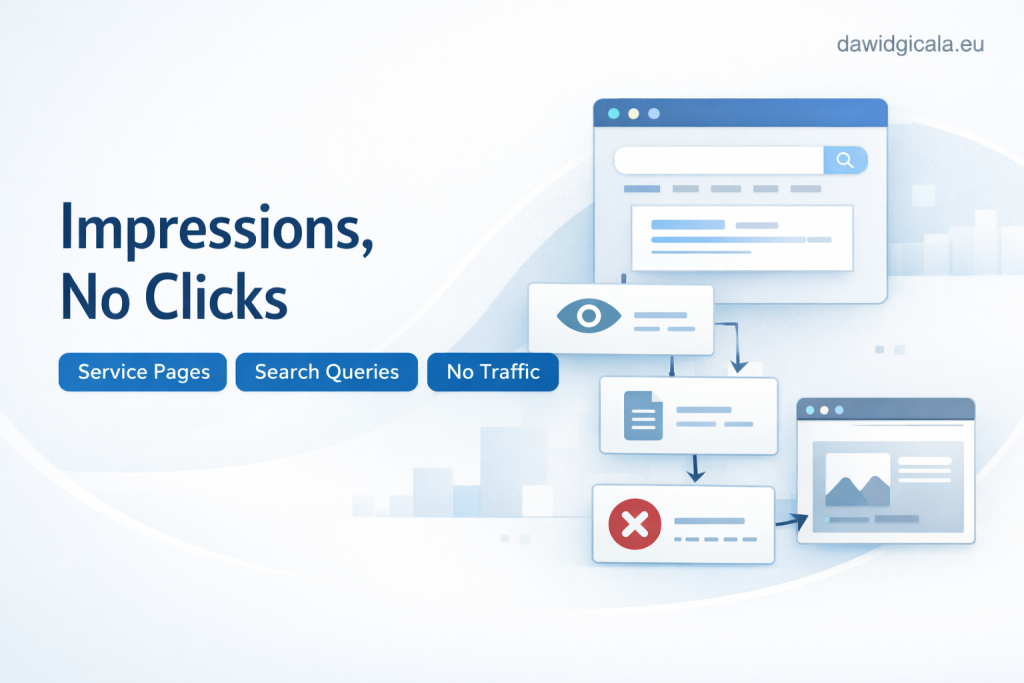
A useful SEO audit should slow that process down and help separate symptoms from causes. If a page has impressions but no clicks, the issue may be search intent, weak titles, poor positioning, or a mismatch between the query and the offer. If a page is not indexed, the cause may be duplication, weak value, internal link isolation, or technical signals. Without that first diagnosis, even sensible changes can be made in the wrong order.
What a useful audit should clarify first
The first useful question is not “how many issues are there?” but “which issue is actually limiting the page?” For example, if a service page is crawled and indexed but still performs poorly, adding schema or compressing images may not change much. If the offer itself is unclear, the page structure is weak, and internal links point mostly to blog posts, the main problem is not technical polish. It is strategic page relevance.
What to check in Search Console, search results, and on the page
Google Search Console is often the best starting point because it shows real search behavior, even when the data is limited. Look at which pages get impressions, which queries trigger them, whether clicks go to the right URLs, and whether pages are indexed at all. If one service page gets impressions for broad informational searches but no commercial clicks, that often suggests an intent mismatch rather than a pure visibility issue.
Then compare the page with the actual search result. Is the title specific enough? Does the snippet suggest a clear service outcome or just vague business language? Does the page immediately explain who the service is for, what problem it solves, and what the next step is? A typical scenario is a page ranking weakly for “accountant for small business” while the page headline says only “Professional Financial Support.” That may sound polished, but it creates weak relevance signals for both users and search engines.
How to separate indexing, intent, content, and technical issues
These four areas often get mixed together, which is why some audits become unhelpful. Indexing problems are about whether Google can include the page at all. Intent problems are about whether the page matches what people expect when they search. Content problems relate to depth, clarity, uniqueness, and usefulness. Technical problems involve crawl barriers, duplication signals, poor page setup, or template-level issues.
A practical way to separate them is to ask one question at a time. Is the page indexed? If not, check why before touching the copy. If it is indexed, does it appear for relevant queries? If yes, does it earn clicks? If not, review the title and search intent. If clicks come but users do not engage or the page still feels weak, the offer presentation may be the issue. For example, a plumber’s city page may mention the city name five times but provide no real local context, no service specifics, and no reason for that page to exist separately. That is not mainly a technical problem.
If the problem is not just one missing keyword, it is better to check indexing, intent, structure and the page itself before changing everything at once.
Where website structure and internal links often change the result
Service websites often underperform because the structure does not reflect the actual offer clearly. The homepage gets most of the links, while important service pages are buried in dropdowns, scattered across categories, or linked only from old blog posts. In that situation, even good pages may remain structurally weak because the site does not signal their importance properly.
Internal linking is not just about adding more links. It is about supporting the right URLs with the right context. A common example: a law firm publishes articles about contract issues, employment disputes, and company formation, but none of those posts link naturally to the relevant service pages. The blog attracts some impressions, yet the service section remains disconnected. An audit is useful when it identifies this kind of gap and shows that page relationships are unclear, not just that “more content is needed.”
When content quality is the real SEO problem
Many service pages are technically fine but still too thin to perform well. They may have a heading, a few paragraphs, and a contact form, but they do not explain the service in a way that matches user concerns. This is where content quality matters, not in the sense of writing more words, but in providing clear, specific, decision-making information. Users often need to understand scope, process, type of problem handled, and whether the service fits their situation.
For example, a renovation company may have separate pages for bathroom renovation and kitchen renovation, but both pages use nearly identical copy with only the room name changed. That can make them look interchangeable. Another case is a therapist page that describes values and philosophy well, but says very little about who the sessions are for, what issues are addressed, and how enquiries work. In both cases, the problem is not that the website lacks text. It lacks useful page-level differentiation.
Thin content does not always mean short content
A short page can be useful if it answers a narrow service need clearly. A long page can still be thin if it is repetitive, generic, or padded with vague statements. If an audit simply recommends “add 1,000 words,” that is often not enough. The real question is whether the page helps Google and users understand why this page should exist and why it should represent that service instead of another page on the same website.
How to prioritise fixes without changing everything at once
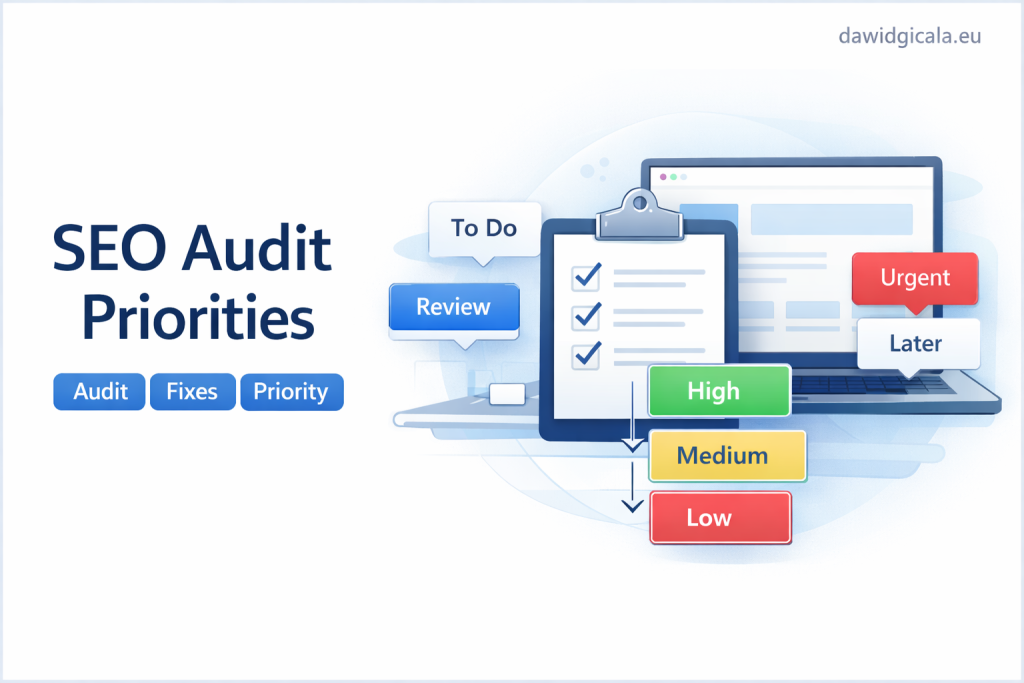
Once the problem is clearer, the next step is prioritisation. A practical SEO audit should help distinguish between high-impact blockers and background issues. If key service pages are not indexed, that comes before visual redesign. If pages are indexed but misaligned with intent, rewriting copy and headings may matter more than plugin settings. If structure is confusing, internal links and navigation may deserve attention before new content production.
One useful approach is to sort findings into three groups: pages that cannot perform because they are blocked or ignored, pages that are visible but weak, and pages that work reasonably well and should not be disrupted. This helps avoid the common mistake of rebuilding everything. A good example is a company that rewrites all service pages after reading a generic audit, only to lose the small amount of existing relevance those pages already had. In many cases, targeted revision beats full replacement.
What usually deserves attention first
Start with pages that are closest to business value and already show signs of life. If Search Console shows impressions for a service page, that page may need refinement, not replacement. If an important page has no impressions and sits three levels deep in the site, the issue may be discoverability and internal support. If several pages compete for similar queries, the first fix may be consolidation or clearer intent separation. This is where an audit can be genuinely useful: it turns scattered observations into a realistic order of action.
How to turn the diagnosis into a realistic action order
A helpful outcome from an audit is not a long spreadsheet with fifty unrelated tasks. It is a sequence that makes sense for the actual website. In practice, that often means starting with one service cluster, checking indexation, reviewing queries and page intent, improving on-page structure, strengthening internal links, and only then deciding whether more supporting content is needed. This reduces random work and makes each change easier to evaluate.
It also helps to treat the website as a system rather than a set of isolated pages. If the offer structure is unclear, fixing one title tag will not solve much. If several pages overlap, adding more blog posts may only make the confusion worse. A practical review should show whether the issue sits on the page, in the section, or across the whole site structure. If you want a clearer view of how this kind of work is approached, dawidgicala.eu gives a useful starting point for understanding service-focused SEO support.
When SEO feels unclear, a practical diagnosis is usually more useful than adding more random content or changing tools without a plan.
SEO audit – Frequently Asked Questions
Service website owners often do not need more SEO activity. They need a clearer explanation of what is happening and what deserves attention first. These questions usually come up once weak visibility starts to feel inconsistent or difficult to explain.
How do I know whether my website needs an SEO audit or just page improvements?
If one or two pages are clearly underwritten but the rest of the site is structurally sound, focused page improvements may be enough. If visibility is unclear across multiple service pages, indexing seems inconsistent, or you cannot tell whether the problem is technical or content-related, an audit is usually more useful first.
My pages are indexed, so why are they still not getting the right clicks?
Indexing only means the pages can appear in Google. It does not mean they match the right search intent or present the offer clearly. If impressions appear but clicks stay low, check titles, snippets, and whether the page actually answers the query behind those impressions.
Can an SEO audit help if Search Console shows impressions but almost no traffic?
Yes, because that pattern often points to a diagnosis problem rather than a pure technical failure. It may suggest weak query targeting, unclear snippets, poor positioning for broad searches, or service pages that are visible for terms that do not lead to action.
Should I rewrite all service pages after receiving an audit?
Usually not. A full rewrite can remove useful signals along with the weak parts. It is often better to identify which pages need stronger intent matching, which need clearer structure, and which should be left relatively stable.
What if my audit mostly recommends tools, plugins, and technical fixes?
That may be useful in some cases, but it is worth checking whether those changes relate to the real performance issue. A service website can be technically tidy and still underperform because the offer structure is vague, internal links are weak, or pages do not match what searchers expect.
Can internal linking really matter that much for service pages?
Yes, especially on smaller websites where service pages have limited external signals. If blog posts, category pages, and navigation do not support the main offer URLs, Google may struggle to understand which pages are most important and how they relate to specific search themes.
When is an SEO audit just another report?
Usually when it lists many generic recommendations without showing which issue is primary, which pages matter most, and what should happen first. A useful audit reduces confusion. A weak one increases it by treating every issue as equally urgent.
MY SERVICES
Choose the service that fits your project
Choose the area where you need a concrete implementation, better results or further development.
Search engine optimization
Content, landing pages, internal linking and ongoing organic visibility growth.
View SEO servicesWordPress & WooCommerce Websites
New websites and online stores, technical improvements and further development.
View website servicesGoogle Ads | Offer
Campaign setup, management and ongoing optimisation.
View Google Ads servicesSponsored posts and link building
Publications, content and external links matched to your industry and project.
View link building services