Local Service SEO on WordPress is one of the simplest ways to bring more clients to a small, service-based business. When your website is structured clearly, answers real questions, and sends strong local signals, Google treats it as the best result for people searching in your area. The good news? You don’t need complex tools or advanced technical knowledge. With the right setup, even a simple WordPress website can start generating steady leads every week.
What is Local Service SEO on WordPress and why it matters?
Local Service SEO on WordPress is the process of optimizing your website so that local customers can find you when they search for services in their area. It focuses on clear page structure, useful content, location signals, customer trust elements, and technical settings that help Google understand what you offer and where you operate. For small businesses, this isn’t “nice to have”, it’s one of the few marketing channels that brings steady, predictable inquiries without paying for every click.
For local service providers such as electricians, cleaners, beauty salons, contractors, coaches, or consultants, visibility in Google Maps and local organic results directly affects the number of calls and form submissions. When your WordPress site is built with the right structure and signals, Google treats it as a reliable local business, which increases your chances of appearing above national competitors or directory sites.
How Local Service SEO on WordPress works in practice?
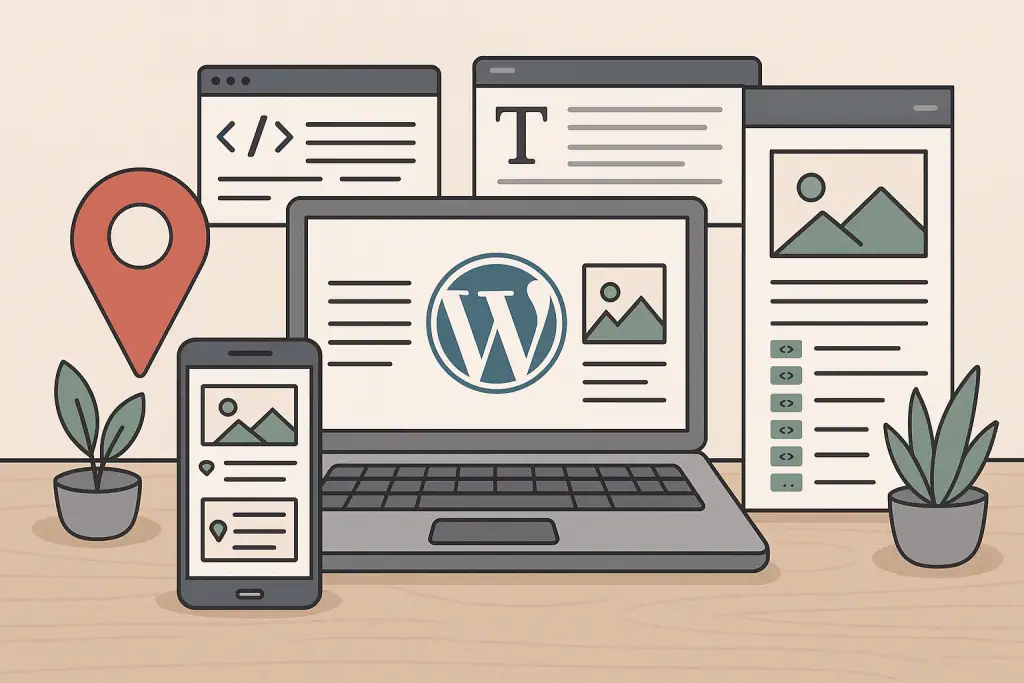
In practice, Local Service SEO on WordPress combines three things: on-page optimization, local signals, and technical configuration. On-page means creating clear service pages, writing human-friendly descriptions, and adding helpful information like pricing, service range, and FAQs. Every service should have its own URL, this gives Google distinct, indexable “answers” for specific searches.
Local signals are everything that tells Google where you operate. This includes embedding a service area, adding addresses consistently, linking your WordPress site with Google Business Profile, and using schema markup that describes your business type and location. Even small things, like naming your images logically or adding testimonials with local context, help Google connect your business to your area.
Finally, technical elements ensure that your site loads quickly and is easy to crawl. WordPress doesn’t need to be complicated, a lightweight theme, optimized images, clean navigation, and proper internal linking make a big difference. Google rewards websites that behave predictably, are easy to understand, and answer local user intent without unnecessary complexity.
Why you should use Local Service SEO on WordPress?
Most local businesses struggle not because they have bad services, but because potential customers simply can’t find them. Local Service SEO on WordPress helps you show up exactly when someone nearby is ready to book or call. Unlike social media or paid ads, the traffic from local SEO is stable, long-term, and doesn’t disappear when you stop paying for promotion.
For many small companies, this is the most cost-effective marketing channel. A well-optimized site can generate inquiries every week with no ongoing ad spend. And because WordPress gives full control over structure, design, and content, it’s much easier to build a website that ranks well compared to closed SaaS builders.
How to implement Local Service SEO on WordPress step by step?
Start with your site structure. Every core service should have its own dedicated page, not a single “our services” list with short descriptions. Google ranks pages, not categories. If you offer plumbing, heating, and boiler repair, each of these needs its own URL, optimized title, useful content, pricing info, and local keywords. Make your navigation simple: Home → Services → Specific service → Contact. Clear paths help both users and Google.
Next, create helpful, real-world content that answers questions your clients actually have: “How long does it take?”, “What does it cost?”, “What should I prepare?”, “Do you work evenings?”, “Which areas do you cover?”. Add short blocks such as pricing ranges, checklists, testimonials, and before/after photos. For local businesses, trust is everything, real examples work far better than generic text.
Finally, configure your local signals and schema. Add your service area, webhook your site with Google Business Profile, embed a map, and use LocalBusiness schema (can be done with plugins like Rank Math or manually). Make sure your NAP (name, address, phone) is consistent across your site and all business listings. Even details like alt tags in images or internal linking between service pages strengthen your local visibility.
Common mistakes and how to avoid them
One of the biggest issues is merging all services onto one page, which makes it impossible for Google to understand what you really offer. Each service should stand alone. Another common mistake is over-optimizing, stuffing keywords, repeating city names unnaturally, or writing text that sounds artificial. Modern SEO rewards clarity and helpfulness, not keyword tricks.
Another frequent problem is weak local signals. Missing address, unclear service area, inconsistent phone numbers, or outdated opening hours confuse Google. Many websites also rely on heavy themes or dozens of plugins, making the site slow. A slow local service site loses both rankings and potential clients.
How Local Service SEO on WordPress affects results, sales, and visibility?
When Local Service SEO is done correctly, the first noticeable change is an increase in local impressions, your pages start appearing for “near me” and city-based searches. Over time, this translates into more phone calls, form submissions, and direct visits to your contact page. WordPress allows you to track these actions easily, so you can clearly see which services bring the most leads.
Good structure and schema also help Google understand your offer faster, which often results in richer search snippets, better rankings, and more trust from the algorithm. Users spend more time on well-structured pages, and this naturally leads to more conversions. For many small service businesses, local SEO becomes the main source of steady, predictable income.
When Local Service SEO on WordPress is especially valuable?
Local Service SEO becomes crucial when your business relies on customers from a specific area, whether it’s one district, a city, or several nearby towns. Electricians, cleaners, beauty studios, pet services, contractors, therapists, handymen, and similar businesses depend on being found quickly by people who are ready to book today, not in a month. WordPress gives you the flexibility to highlight your exact service areas and tailor your content to local intent.
It’s also extremely valuable when you want to compete with big portals or national brands. Large companies often dominate general keywords, but local search is a different game. With the right structure, schema, and location signals, Google will often prefer a smaller, local WordPress website over a large brand, simply because you’re more relevant to the user searching nearby.
How to combine Local Service SEO on WordPress with other tools and strategies?
Local Service SEO works best when it’s supported by other channels. Connecting your WordPress site with Google Business Profile allows you to reinforce your address, phone number, and customer reviews. Ads can also complement SEO, running a small-budget local campaign on Google or Meta helps you appear consistently while your SEO efforts grow in the background.
You can also combine it with simple content marketing. Short how-to guides, local case studies, or “before/after” photos posted on your blog strengthen your topical authority and give Google more signals about the services you specialise in. Tools like Rank Math, GA4, Search Console, and heatmaps can help you analyse what’s working and identify gaps in your structure.
What to do if problems or errors appear?
If your rankings drop, start by checking the basics: Is your NAP still consistent? Are your service pages accessible? Has your theme or plugin update changed something important? Many issues come from simple technical problems like broken internal links, missing schema, or accidentally removed H1 headers. Fixing these often brings your visibility back within days.
For more complex issues, like sudden drops after a Google update, review whether your content truly answers user intent. Thin text, generic descriptions, or missing service areas are red flags. Sometimes small improvements, like adding real examples, pricing, FAQs, and local cues, are enough to regain lost positions. If debugging becomes overwhelming, do not hesitate to reach out for help.
Who should handle Local Service SEO on WordPress?
Local Service SEO can be managed by a business owner, but only if the website is small and you’re comfortable making basic updates. Many service providers start on their own, but eventually run into technical limits: schema configuration, crawling issues, slow performance, or problems with local rankings. That’s usually the moment when handing SEO to a specialist makes a noticeable difference.
A professional who understands WordPress can build a clean structure, add the right schema, fix hidden errors, and shape your content so Google and local customers instantly understand what you offer. This typically results in more calls, more form submissions, and stronger visibility in your service area, without relying on paid ads.
👉 Need expert help with Local Service SEO on WordPress?
Local Service SEO on WordPress – Frequently Asked Questions
Local Service SEO often brings up similar doubts among small business owners.
How long does Local Service SEO on WordPress take to show results?
Most local businesses notice first improvements after 4–8 weeks, with stronger and more stable visibility after 3-6 months.
Do I need separate pages for each service?
Yes. Google ranks individual pages, not a single “services” list. Each service deserves its own page with clear content.
What is the most important ranking factor for local service websites?
A clean structure and strong local signals: address, service area, internal links, and schema.
Does schema really matter for local SEO?
Yes. Schema helps Google understand your business type and location faster, which improves local visibility.
Can I do Local Service SEO without Google Business Profile?
You can, but you will lose a large portion of potential traffic. GBP is essential for local intent searches.
Does page speed affect local rankings?
Definitely. Slow pages lead to lower rankings and fewer conversions because users simply leave.
How many plugins are too many for WordPress?
There’s no exact number. The real problem is unnecessary plugins that add bloat. Lightweight plugins keep your site fast.
What if competitors have stronger domains or more reviews?
Local SEO still gives you a strong chance. Google prioritizes relevance to the searcher’s location, not just domain authority.